
Yan Cui
I help clients go faster for less using serverless technologies.
In C#, there are two ways you can provide an alternative implementation of an inherited method:
Override a virtual method
Unlike Java where every method can be overridden by default unless marked with the final keyword, C# employs a safer, opt-in system where methods cannot be overridden unless marked with the virtual keyword.
A virtual method defined in the base class can be overridden in a derived class by defining a method with the same signature and marking it with the override keyword.
Hiding a base method
Without marking a method in the base class with the virtual keyword it is still possible (albeit not recommended) to provide an override by ‘hiding’ the method defined in the base class. All you need to do is to declare the same method signature in the derived class.
Philosophical Difference
Under normal circumstances, hiding a base method is a code smell. It unnecessarily complicates the relationship between the base and derived class as it’s not immediately clear which method is invoked when you call derived.Foo() if Foo() is declared in both the base and derived class.
To lessen this confusion, you should use the new keyword whenever you absolutely have to hide a method in the base class:
public class BaseClass
{
    public void Foo() { … }
}

public class DerivedClass
{
    public new void Foo() { … }
}
This way, when someone looks at your code it at least offers some indication that Foo() is an override and more importantly, it makes a statement of your intention to hide the Foo() method in the base class (as opposed to it looking like a mistake).
Overriding a virtual method on the other hand, is very much part and parcel of object oriented design, and an integral part of the Template pattern (one of my favourites :-P) to allow variations in the behaviour of the concrete classes. It allows you to make a clear statement both in the base and derived class that a method is intended and sometimes expected to be overridden.
Semantic Difference
Semantically there’s a very subtle difference between the two approaches because the timing in which the method to invoke is determined differs between the two:
- When you hide a base method the method is resolved at compile time – which method is invoked at runtime is predetermined based on what they look like at compile time and baked into the compiled dll.
- When you override a virtual method the method is resolved at runtime – the CLR determines which method to invoke by looking up a ‘call table’ and find the nearest override of the method.
Here’s a scenario where you will notice the difference:
Imagine you have two classes TypeA and TypeB, located in AssemblyA and AssemblyB respectively:
public class TypeA // in AssemblyA.dll
{
    public void Foo()
    {
        Console.Write("TypeA.Foo()");
    }

    public virtual void Boo()
    {
        Console.Write("TypeA.Boo()");
    }
}

public class TypeB : TypeA // in AssemblyB.dll
{
}
In my application which uses both libraries, I have these lines of code:
var typeb = new TypeB();
typeb.Foo();
Console.WriteLine();
typeb.Boo();
And no prizes for guessing the output of this code:
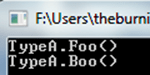
Now, suppose I decided at a later date that I wish to override Foo() and Boo() in TypeB:
public class TypeB : TypeA // in AssemblyB.dll
{
    public void Foo()
    {
        Console.Write("TypeB.Foo()");
        base.Foo();
    }

    public override void Boo()
    {
        Console.Write("TypeB.Boo()");
        base.Boo();
    }
}
Seeing as nothing else have changed, so I recompile only AssemblyB and distribute the new dll, what do you think the output is when I rerun my application? Well, a little surprisingly:
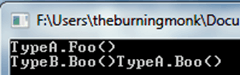
References:
Eric Lippert’s blog post: putting a base in the middle
Whenever you’re ready, here are 4 ways I can help you:
- If you want a one-stop shop to help you quickly level up your serverless skills, you should check out my Production-Ready Serverless workshop. Over 20 AWS Heroes & Community Builders have passed through this workshop, plus 1000+ students from the likes of AWS, LEGO, Booking, HBO and Siemens.
- If you want to learn how to test serverless applications without all the pain and hassle, you should check out my latest course, Testing Serverless Architectures.
- If you’re a manager or founder and want to help your team move faster and build better software, then check out my consulting services.
- If you just want to hang out, talk serverless, or ask for help, then you should join my FREE Community.
Great story and example