
Yan Cui
I help clients go faster for less using serverless technologies.
Two weeks ago, I gave you the biggest serverless announcements pre-re:Invent (see here). So here are the biggest serverless announcements during re:Invent 2025.
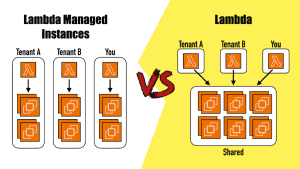
Lambda Managed Instances
Here’s the official announcement.
A common pushback against Lambda is that “it’s expensive at scale” because:
1) Each execution environment can only process one request at a time, wasting available CPU cycles while you wait for IO response.
2) Paying for execution time is less efficient when handling thousands of requests per second, especially given the above.
Lambda Managed Instances address these concerns.
You keep the same programming model with Lambda and the same event triggers.
But instead of your function running in a shared pool of bare metal EC2 instances, you can now instruct AWS to use EC2 instances from your account instead. Importantly, AWS still manages these EC2 instances for you, including OS patching, load balancing and auto-scaling.
It gives you more control and flexibility, e.g. what instance types to use (but no GPU instances) and the memory-to-CPU ratio.
See this post for my more in-depth coverage of this new feature.
Lambda Durable Functions
Here’s the official announcement.
This is my favourite announce from re:Invent 2025 :-)
Lambda Durable Functions use a replay mechanism similar to how reState works and how I implemented durable execution on Lambda for a client project.
The basic idea is simple – you can add checkpoints along the execution and the Lambda service will re-invoke your function from the start and skip over previously executed checkpoints when:
- The initial invocation timed out.
- You called context.wait to pause the current invocation.
- You used context.invoke to invoke another function and wait for its response (which suspends the current invocation).
- You created a callback and awaiting its response.
Here’s a handy visualization from the official documentation.
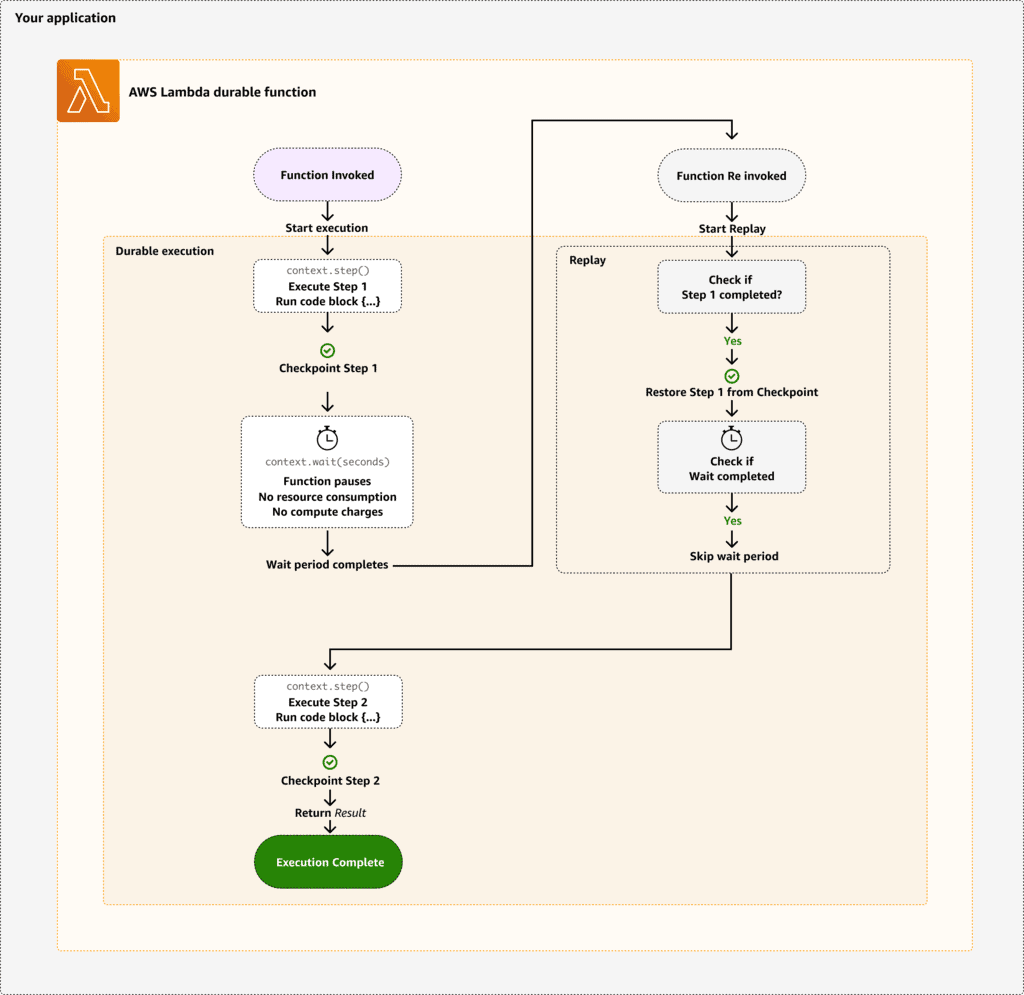
(source: https://docs.aws.amazon.com/lambda/latest/dg/durable-functions.html)
In addition to the usual Lambda function timeout (max 15 mins), Durable Functions also have a “execution timeout” for the total duration of a durable execution which can span over multiple invocations. The max execution timeout is 1 year.
Durable functions can be invoked both synchronously and asynchronously.
However, for synchronous invocations, the max execution timeout is limited to 15 mins. Whereas asynchronous invocations can have execution timeout of up to 1 year.
Durable functions also work with all event source mappings. But ESM-triggered invocations are also limited to a max execution duration of 15 mins.
Additionally, Durable Functions support DLQs, but they DO NOT support Lambda destinations.
Similar to Step Functions, Durable Functions also supports exactly-once processing, if you provide an “DurableExecutionName” when invoking a durable function.
Durable Functions blur the line between Lambda and Step Functions. I’m still organizing my thoughts on how to choose between them, but off the top of my head, these are areas where I think Step Functions wins over Lambda Durable Functions:
- Visualization: being able to design and visualize the workflow as well as its executions. This is especially useful when working with non-technical stakeholders.
- Parallel processing: the context.parallel function of the Durable execution SDK does not actually guarantee parallel processing. In Node.js, it’s essentially a wrapper around promise.all, which gives you concurrency, not parallelism. So if you need to process large amounts of data in parallel, e.g. as part of a map-reduce task, then you want Step Function’s Parallel state.
The replay mechanic also has some interesting failure modes and gotchas. More on that in another post! Or, you can learn all about them in my next Production-Ready Serverless workshop ;-)
S3 Vectors goes GA with better scale and performance
Here’s the official announcement.
S3 Tables support intelligent-tiering and replication
Here’s the official announcement.
CloudFront supports mutual TLS authentication
Here’s the official announcement.
And a lot of AI-related announcements, such as Nova 2 models.
Related Posts

Whenever you’re ready, here are 3 ways I can help you:
- Production-Ready Serverless: Join 20+ AWS Heroes & Community Builders and 1000+ other students in levelling up your serverless game. This is your one-stop shop for quickly levelling up your serverless skills.
- I help clients launch product ideas, improve their development processes and upskill their teams. If you’d like to work together, then let’s get in touch.
- Join my community on Discord, ask questions, and join the discussion on all things AWS and Serverless.